Saturday, June 27, 2009

Internet Groans Under Weight of Michael Jackson Traffic by Jacqui Cheng


The news of pop icon Michael Jackson's collapse and subsequent death sent ripples across the Web on Thursday afternoon, affecting numerous services and sparking yet another spam campaign. Twitter, Google, Facebook, various news sites, and even iTunes were practically crushed under the weight of the sudden spike in Internet traffic. The phenomenon may not be new on an individual level, but combined across services, it was truly one of the most significant in recent memory.

When news first broke that the Jackson had collapsed in his home, Twitter was immediately abuzz. There were several points when the Ars staff observed between 6,000 and 13,000 new tweets per minute mentioning Michael Jackson before Twitter began to melt down—all before anyone other than TMZ.com was reporting his death. Of course, most of us are intimately familiar with the famed Fail Whale at this point, though Twitter's meltdown was mostly reflected in a major slowing of the service and the inability to send new tweets.

In fact, Twitter cofounder Biz Stone told the L.A. Times that the news of Jackson's passing caused the biggest spike in tweets per second since the US Presidential Election. (Similarly, Facebook—also known as Wannabe Twitter—saw a spike in status updates that was apparently three times more than average for the site, though a spokesperson said the site remained free of performance issues.)

Google, on the other hand, began receiving so many searches for news about Jackson that it caused the search engine to believe it was under attack. The site went into self-protection mode, throwing up CAPTCHAs and malware alerts to users trying to find news. A Google spokesperson described the incident as "volcanic" compared to other major news events, confirming that there was a service slowdown for some time.

The spammers have come out in droves as well (never assume that someone isn't working on a way to instantaneously exploit the death of a major celebrity). Security researchers at Sophos put up a warning this morning saying that the first wave of spam messages has gone out claiming to have "vital information" regarding Jackson's death. There doesn't appear to be any call to action or URL, but is meant as a way to harvest e-mail addresses if recipients make the mistake of replying. We're sure this trend will continue in the coming days, not just about Michael Jackson, but also actress Farrah Fawcett (who also passed earlier in the day on Thursday), and former Tonight Show sidekick Ed McMahon.

Finally, Apple's iTunes Store appeared to experience some slowdowns upon the confirmation of Jackson's passing, though the service has been running smoothly since. Users, however, are paying (literally) tribute to MJ, as several of Jackson's hit singles are climbing into the iTunes Top 10, including "Man In the Mirror," "Thriller," and "Don't Stop 'Til You Get Enough." This is pretty impressive considering that he has made the list with three songs in less than 24 hours, competing with the likes of Black Eyed Peas' "Boom Boom Pow" (which has been close to the top of the iTunes Top 10 for what seems like three millennia—seriously, please quit buying it so it goes away).

Coupled with news that fans have been gathering in cities across the US to perform the renowned (if not a bit morbid, all things considered) Thriller zombie dance, we can't help but feel as if the user-driven age of the Internet will keep his memory alive in ways that past music icons have not had. (Only a couple of Ars staffers—we're looking at you Bangeman and Timmer—are old enough to remember the passing of Elvis Presley in 1977, which dominated newspapers and TV for days afterwards.) YouTube even has a Michael Jackson spotlight on its front page right now, so if you're feeling nostalgic, head on over and check out MJ's smooth moves from the days of yore. R.I.P., King of Pop.

Tuesday, June 23, 2009

The Ins and Outs of Borderline Tennis Calls by Alan Schwarz


When a line judge at Wimbledon rules on a hair-splittingly close call and says the ball is out, the inevitably disgruntled player should not only consider challenging the call for review by digital replay system.

He should consult a recent issue of Current Biology.

A vast majority of near-the-line shots called incorrectly by Wimbledon line judges have come on balls ruled out that were actually in, according to a study published in October by researchers at the University of California-Davis. To the vision scientist, the finding added to the growing knowledge of how the human eye and brain misperceive high-speed objects. To the tennis player, it strongly suggests which calls are worth challenging and which are best left alone.

The researchers identified 83 missed calls during the 2007 Wimbledon tournament. (Some were challenged by players and overruled, and others were later identified as unquestionably wrong through frame-by-frame video.) Seventy of those 83 calls, or 84 percent, were on balls ruled out — essentially, shots that line judges believed had traveled farther than they actually did.

Called perceptual mislocalization by vision scientists, this subconscious bias is known less formally to Wimbledon fans as “You cannot be serious!” — John McEnroe’s infamous dissent when, yes, a 1981 shot was ruled out. Now that players can resort to a more evolved appeal procedure, the researchers’ discovery suggests that players should generally use their limited number of challenges on questionable out calls rather those that are called in, because such out calls have a far better chance of being discovered as mistaken on review, then overturned.

“What we’re really interested in is how visual information is processed, and how it can be used to a player’s advantage,” said David Whitney, an associate professor at U.C.-Davis’s Center for Mind and Brain and the paper’s lead author. “There is a delay of roughly 80 to 150 milliseconds from the first moment of perception to our processing it, and that’s a long time. That’s one reason why it’s so hard to catch a fly — the fly’s ability to dance around is faster than our ability to determine where it is.”

This is the third Wimbledon in which players can challenge questionable calls for review by the Hawk-Eye system, which uses high-speed video cameras to record balls’ flight. (About 25 percent of all challenges result in overturned calls.) There is no cost to the player when a call is proved correct, but after three such episodes in a set a player may not challenge again. Whether through strategy or residual tennis etiquette, most players leave many challenges unused.

Theoretically, line judges should be equally prone to call an out ball in as they are an in ball out. But when objects travel faster than humans’ eyes and brains can precisely track them — for example, Andy Roddick’s 150-mile-per-hour serves — they are left having to fill in the gaps in their perception. In doing so they tend to overshoot the object’s actual location and think it traveled slightly farther than it truly did.

Both successful challenge calls as well as the overlooked mistakes that the researchers later identified were several times more likely to come on “long” calls than “in” calls. (The same pattern existed at Wimbledon last year, Whitney said, although the paper did not present that data.) So players are better off using as many challenges as possible on balls called out, because those are the calls most likely to be wrong; if a player thinks an “in” call was wrong, chances are his own eyes were as fooled as line judges’ sometimes are.

Without knowing it, tennis officials are already told to try to compensate for this mislocalization effect. Published instructions for United States Tennis Association line judges tell them to “focus your eyes on the portion of the line where the ball will land,” rather than attempt to track the ball in flight. “Get to the spot well before the ball arrives,” they are advised.

Rich Kaufman, the association’s director of officials and a linesman and chair umpire from 1976 to 1997, said that of all things “one of the hardest things to teach new linesmen is to take their eye off the ball.”

“I once asked an eye doctor, then what am I seeing on a bounce?” Kaufman said. “The doctor said that’s your brain working — you think you see the initial point of impact but it’s the blur of the entry and exit of the ball.”

A player using his knowledge of this effect in challenging calls could see a benefit of about one or two overturned points per match, Whitney said, plus any psychological boost from feeling vindicated rather than robbed. But Whitney added that understanding how the brain misperceives visual stimuli can help in more real-life matters, like the design and placement of high-speed safety equipment, automobile brake lights and warning signs of all types.

As for Wimbledon, it appears as if the new information can only help players, not the judges who vex them. Kaufman said: “You have to call what you see. Or what you think you see.”

Monday, June 22, 2009

Why the Eyes Have it by Christopher Chabris


Why are we ­humans so good at seeing in color? Why do we have eyes on the front of our heads rather than on the sides, like horses? And how is it that we find it so easy to read when written language didn’t even exist until a few thousand years ago—a virtual millisecond in evolutionary time?
Most of us, understandably, have never given much thought to questions like these. What is surprising is that most cognitive scientists ­haven’t either. People who study the brain generally ask how it works the way it does, not why. But Mark Changizi, a professor at Rensselaer ­Polytechnic Institute and the author of “The Vision ­Revolution,” is indeed a man who asks why, and lucky for us: His ideas about the brain and mind are fascinating, and his explanations for our habits of seeing are, for the most part, persuasive.
Mr. Changizi takes care not to call himself a practitioner of evolutionary psychology. This is the one discipline of the mind sciences that focuses on why questions, but it often answers them by telling just-so stories that cannot be ­disproved. (Why do men have better spatial ability than women? Because a long time ago, in Africa, men needed spatial skills to track prey and to kill at a distance—a plausible theory but one that is difficult to test with experiments.) Instead Mr. Changizi calls ­himself a “theoretical neuroscientist,” seeking explanations for the design of the mind that are based on mathematical and physical analysis. He has his own stories, it is true, but they are grounded solidly in neuroscience, and they are backed up by data about a surprising range of human activities, from ­the colors found in historical ­costumes to the ­correspondence between the shapes found in written letters and the shapes found in ­nature.
Let’s start with the question of color. It is such a natural part of our visual experience that we don’t stop to wonder why we can see it at all. ­Without color television there would have been no “Miami Vice,” of course, but were we really missing out on so much when we had only black and white? The consensus explanation for our superior ability to perceive color is that primates evolved it to see fruit—you can’t order dinner if you can’t read the menu.
Mr. Changizi thinks otherwise. He proposes that color vision is useful for distinguishing the changes in other ­people’s skin color—changes that are caused by shifts in the volume and oxygenation levels of the blood. Such shifts, like blushing, often signal emotional states. The ability to see them is adaptive because it helps an observer to “read” states of mind and states of health in others, information that is in turn useful for predicting their behavior.
Our brains evolved in a time when people lived their entire lives without ever seeing someone with a skin color different from their own. Thus the skin color we grow up seeing, Mr. Changizi says, is “neutral” to us: It serves as a kind of baseline from which we notice even minor deviations in tint or hue. Almost every language has distinct words for some 11 basic colors, but none of them aptly describe the look of skin, which seems colorless (except in our recent multicultural societies, where skin color is newly prominent). As one might expect, primates without color vision tend to have furry faces and hands and thus less need to perceive skin color; ­primates with color vision are more “naked” in this respect, humans most of all.
James Steinberg
Conventional wisdom may be similarly misleading when it comes to binocular vision. It is said that we have two forward-facing eyes, which send our brains two separate images of almost everything in our field of view so that the brain can compare those images to estimate the distance of objects—a generally useful thing to know. But people who are blind in one eye, Mr. Changizi notes, can perform tasks like driving a car by using other cues that help them to judge distance. He offers a different explanation: that two eyes give us a sort of X-ray vision, allowing us to see “through” nearby objects to what is beyond.
You can experience this ability yourself by closing one eye and holding your forefinger near your face: It will appear in your field of vision, of course, and it will block what lies beyond or behind it. If you open both eyes, though, you will suddenly perceive your finger as transparent—that is, you will see it and see, ­unblocked, the full scene in front of you. Mr. Changizi observes that an animal in a leafy environment, with such an ability, gains an advantage: It can lurk in tall grass and still see what is “outside” its hiding place. He correlates the distance between the eyes and the density of vegetation in the habitats of animals and finds that animals with closer-set eyes do tend to live in ­forests rather than on plains.
As for reading, Mr. Changizi stops to observe how remarkable this ability is and how useful, giving us access to the minds of dead people (i.e., deceased writers) and permitting us to take in words much faster than we can by merely listening to them. He claims that we learn to read so easily because the symbols in our written alphabets have evolved, over many generations, to resemble the building blocks of natural scenes—­exactly what previous millennia of evolution adapted the brain to perceive quickly. A “T,” for example, appears in nature when one object overlaps ­another, like a stone lying on top of a stick. With statistical analysis, Mr. Changizi finds that the contour patterns most common in nature are also most common in letter shapes.
Mr. Changizi has more to say about our visual experience—about optical illusions, for instance, which he sees as artifacts of a trick the brain uses to cope with the one-tenth of a second it takes to process the light that hits our eyes and to determine what is actually in front of us. He calls for a new academic discipline of “visual linguistics,” and he tells us why there are no ­species with just one eye.
What does all this add up to? Provocative hypotheses but not settled truth—at least not yet. As a theoretician, Mr. Changizi leaves it to others to design experiments that might render a decisive ­verdict. Someone else will have to study how accurately people can perceive mental states from shifting skin tones, and someone else will have to ­determine whether, in most cases, looking at another ­person’s skin adds any useful information to what is easily known from facial expression, tone of voice and body ­language.
Still, the novel ideas that Mr. Changizi outlines in “The Vision Revolution”—together with the evidence he does present—may have a big effect on our understanding of the human brain. Their implication is that the environments we evolved in shaped the design of our visual system according to a set of deep principles. Our challenge now is to see them clearly.

Thursday, June 18, 2009

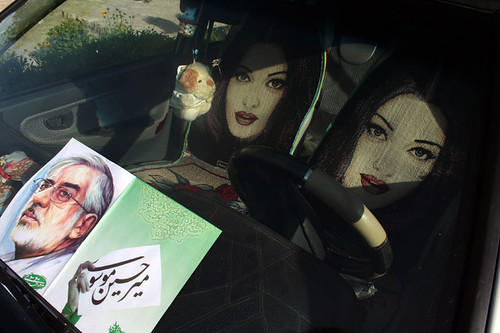
I never thought I'd be rooting for Iran by Bradley Burston


I never thought I'd be rooting for Iran 

I am in awe of the courage of the people of Iran They are giving the world hope. They are teaching a shocking lesson about truth. They embody freedom. And, perhaps hardest to grasp, for those of us who live in the Middle East, they are putting their very lives on the line not for the sake of some ferociously sectarian End of Days, but for the most profoundly radical notion of all - a better life. 

Every person who has taken to the streets to demand what their government promised them, free and fair elections, did so knowing that police or secret police could arrest them, act to cripple their careers, or outright gun them down

Tuesday, June 16, 2009

Don't Call What Happened in Iran Last Week an Election by Christopher Hitchens


For a flavor of the political atmosphere in Tehran, Iran, last week, I quote from a young Iranian comrade who furnishes me with regular updates:
I went to the last major Ahmadinejad rally and got the whiff of what I imagine fascism to have been all about. Lots of splotchy boys who can't get a date are given guns and told they're special.
It's hard to better this, either as an evocation of the rancid sexual repression that lies at the nasty core of the "Islamic republic" or as a description of the reserve strength that the Iranian para-state, or state within a state, can bring to bear if it ever feels itself even slightly challenged. There is a theoretical reason why the events of the last month in Iran (I am sorry, but I resolutely decline to refer to them as elections) were a crudely stage-managed insult to those who took part in them and those who observed them. And then there is a practical reason. The theoretical reason, though less immediately dramatic and exciting, is the much more interesting and important one.
Iran and its citizens are considered by the Shiite theocracy to be the private property of the anointed mullahs. This totalitarian idea was originally based on a piece of religious quackery promulgated by the late Ayatollah Ruhollah Khomeini and known as velayat-e faqui. Under the terms of this edict—which originally placed the clerics in charge of the lives and property of orphans, the indigent, and the insane—the entire population is now declared to be a childlike ward of the black-robed state. Thus any voting exercise is, by definition, over before it has begun, because the all-powerful Islamic Guardian Council determines well in advance who may or may not "run." Any newspaper referring to the subsequent proceedings as an election, sometimes complete with rallies, polls, counts, and all the rest of it, is the cause of helpless laughter among the ayatollahs. ("They fell for it? But it's too easy!") Shame on all those media outlets that have been complicit in this dirty lie all last week. And shame also on our pathetic secretary of state, who said that she hoped that "the genuine will and desire" of the people of Iran would be reflected in the outcome. Surely she knows that any such contingency was deliberately forestalled to begin with.
In theory, the first choice of the ayatollahs might not actually "win," and there could even be divisions among the Islamic Guardian Council as to who constitutes the best nominee. Secondary as that is, it can still lead to rancor. After all, corrupt systems are still subject to fraud. This, like hypocrisy, is the compliment that vice pays to virtue. With near-incredible brutishness and cruelty, then, the guardians moved to cut off cell-phone and text-message networks that might give even an impression of fairness and announced though their storm-troop "revolutionary guards" that only one form of voting had divine sanction. ("The miraculous hand of God," announced Supreme Leader Ali Khamenei, had been present in the polling places and had announced a result before many people had even finished voting. He says that sort of thing all the time.)
The obvious evidence of fixing, fraud, and force to one side, there is another reason to doubt that an illiterate fundamentalist like Mahmoud Ahmadinejad could have increased even a state-sponsored plebiscite-type majority. Everywhere else in the Muslim world, in every election in the last two years, the tendency has been the other way. In Morocco in 2007, the much-ballyhooed Justice and Development Party wound up with 14 percent of the vote. In Malaysia and Indonesia, the predictions of increased market share for the pro-Sharia parties were likewise falsified. In Iraq this last January, the local elections penalized the clerical parties that had been making life a misery in cities like Basra. In neighboring Kuwait last month, the Islamist forces did poorly, and four women—including the striking figure of Rola Dashti, who refuses to wear any headgear—were elected to the 50-member parliament. Most important of all, perhaps, Iranian-sponsored Hezbollah was convincingly and unexpectedly defeated last week in Lebanon after an open and vigorous election, the results of which were not challenged by any party. And, from all I hear, if the Palestinians were to vote again this year—as they were at one point supposed to do—it would be highly improbable that Hamas would emerge the victor.
Yet somehow a senile and fanatical religious clique that has failed even to condition the vote in a country like Lebanon, where it has proxy and surrogate parties under arms, is able to reward itself by increasing its "majority" in a festeringly bankrupt state where it controls the media and enjoys a monopoly of violence. I think we should deny it any official recognition of this consolation. (I recommend a reading of "Neither Free Nor Fair: Elections in the Islamic Republic of Iran" and other productions of the Abdorrahman Boroumand Foundation. This shows that past penalties for not pleasing the Islamic Guardian Council have included more than mere disqualification and have extended to imprisonment and torture and death, sometimes in that order. A new movie by Cyrus Nowrasteh, The Stoning of Soraya M., will soon show what happens to those who dare to dissent in other ways and are dealt with by Ahmadinejad's "grass roots" fanatics.)
Mention of the Lebanese elections impels me to pass on what I saw with my own eyes at a recent Hezbollah rally in south Beirut, Lebanon. In a large hall that featured the official attendance of a delegation from the Iranian Embassy, the most luridly displayed poster of the pro-Iranian party was a nuclear mushroom cloud! Underneath this telling symbol was a caption warning the "Zionists" of what lay in store. We sometimes forget that Iran still officially denies any intention of acquiring nuclear weapons. Yet Ahmadinejad recently hailed an Iranian missile launch as a counterpart to Iran's success with nuclear centrifuges, and Hezbollah has certainly been allowed to form the idea that the Iranian reactors may have nonpeaceful applications. This means, among other things, that the vicious manipulation by which the mullahs control Iran can no longer be considered their "internal affair." Fascism at home sooner or later means fascism abroad. Face it now or fight it later. Meanwhile, give it its right name.

Monday, June 15, 2009

Will the Recession Make Europe's Militaries Weaker? by Thomas Valasek


The economic crisis has wracked government budgets across Europe, as revenues have fallen and spending on stimulus and bailouts has soared. Already, there are signs that defense spending across the continent will suffer. Finance ministers will be looking for ways to reduce deficit and debt, and military budgets are a tempting target.
Such budget cuts will have some salutary effects: Defense establishments, with their resistance to civilian oversight and emphasis on continuity, tend to get bloated in times of relative plenty. It often takes a crisis to force meaningful reforms. But cuts also threaten to sap the effectiveness of European fighting forces and leave parts of the world exposed to insecurity.
The easiest portion of the budget to cut is operations. But it's also the most important portion. Withdrawing soldiers from faraway places plays well at home and requires no layoffs, but it means fewer troops in some of the world's most imperiled regions. Poland announced in April that it would withdraw from all U.N. peacekeeping operations. While the Poles may be no less safe, fragile countries such as Chad and Lebanon still need foreign troops to keep the peace.
Rather than withdrawing from conflict zones, European countries and agencies should stop sending overlapping missions to the same trouble spots. Both the EU and NATO sent missions to Sudan in 2007, and three different forces are currently fighting piracy off the coast of Somalia. Better to roll those operations into one; the current duplication wastes taxpayer money.
As defense ministries slash their budgets, their instinct will be to cut multinational weapons programs and make any purchases domestically so as to protect jobs at home. But that carries risks. Many truly necessary systems, such as transport airplanes, are so expensive and complex that they are best funded and shared between countries.
Granted, many past collaborative programs have been disastrous, such as the seven-nation plan to develop the A400M military transport aircraft. A modern-day Spruce Goose, the plane cannot fly because its engines, made by a four-nation European consortium, lack the proper certification; the plane is also said to be too heavy.
But the trouble with the A400M lies not in the collaborative nature of the program. The plane is a failure because its designers have been more concerned with securing production jobs than with obtaining a good product. In return for investing in the aircraft, they have demanded that a commensurate number of production jobs go to their country. As a result, bits of the plane are being built all over Europe -- and not necessarily in the countries most qualified to do the job.
European governments must be smarter. They should accept that it makes more sense to order the needed parts from the plant with the most relevant technical expertise. The governments also need to be more ready to buy off-the-shelf components, rather than try to generate jobs by manufacturing parts from scratch.
The impact of the budget cuts -- particularly the reductions in personnel and equipment -- also threaten to turn some European militaries into showcase forces, incapable of deploying abroad and thus irrelevant to most EU and NATO operations. It makes little sense, for example, for all but very few allies to keep tanks unless they are upgraded to be able to operate in faraway places such as Afghanistan and unless the governments have access to aircraft big enough to transport the tanks. As an excellent new study commissioned by the Nordic governments concluded, "small and medium-sized countries lose their ability to maintain a credible defence" when certain units shrink too much.
There are two ways to avoid such outcomes while cutting budgets. Some of the key equipment that makes modern warfare possible -- such as planes providing air-to-ground surveillance or military transport -- needs to be jointly owned. NATO operates a common fleet of aircraft that coordinates air traffic, and the alliance plans to buy transport airplanes for its members to use. This arrangement allows militaries of smaller and poorer European states, like the new allies in Eastern Europe, to take part in complex operations in distant places.
But that alone will not generate enough savings. Indeed, the time has come for European governments to consider abandoning parts of their national forces and infrastructure and to form joint units with their neighbors. Modern militaries do virtually all their fighting abroad and in coalition with others. If they lack the money to equip and deploy their soldiers overseas, they need to consider radical cost-saving measures. More governments should do as Belgium, the Netherlands, and Luxembourg did -- they merged parts of their air forces -- or emulate the Nordic countries, which are considering joining their amphibious units.
Most European governments have, in the past, found it too difficult to part with the cherished symbol of national sovereignty that is a proper army or an air force. But the practical value of such military services in Europe is often negligible. As the recession deepens, defense ministers across Europe should see the crisis as an opportunity to combine certain units and programs across countries. This will save money, which could be put to use properly training and equipping forces for EU and NATO operations

The Underworked American by the Economist


AMERICANS like to think of themselves as martyrs to work. They delight in telling stories about their punishing hours, snatched holidays and ever-intrusive BlackBerrys. At this time of the year they marvel at the laziness of their European cousins, particularly the French. Did you know that the French take the whole of August off to recover from their 35-hour work weeks? Have you heard that they are so addicted to their holidays that they leave the sick to die and the dead to moulder?
There is an element of exaggeration in this, of course, and not just about French burial habits; studies show that Americans are less Stakhanovite than they think. Still, the average American gets only four weeks of paid leave a year compared with seven for the French and eight for the Germans. In Paris many shops simply close down for August; in Washington, where the weather is sweltering, they remain open, some for 24 hours a day.
But when it comes to the young the situation is reversed. American children have it easier than most other children in the world, including the supposedly lazy Europeans. They have one of the shortest school years anywhere, a mere 180 days compared with an average of 195 for OECD countries and more than 200 for East Asian countries. German children spend 20 more days in school than American ones, and South Koreans over a month more. Over 12 years, a 15-day deficit means American children lose out on 180 days of school, equivalent to an entire year.
American children also have one of the shortest school days, six-and-a-half hours, adding up to 32 hours a week. By contrast, the school week is 37 hours in Luxembourg, 44 in Belgium, 53 in Denmark and 60 in Sweden. On top of that, American children do only about an hour’s-worth of homework a day, a figure that stuns the Japanese and Chinese.
Americans also divide up their school time oddly. They cram the school day into the morning and early afternoon, and close their schools for three months in the summer. The country that tut-tuts at Europe’s mega-holidays thinks nothing of giving its children such a lazy summer. But the long summer vacation acts like a mental eraser, with the average child reportedly forgetting about a month’s-worth of instruction in many subjects and almost three times that in mathematics. American academics have even invented a term for this phenomenon, “summer learning loss”. This pedagogical understretch is exacerbating social inequalities. Poorer children frequently have no one to look after them in the long hours between the end of the school day and the end of the average working day. They are also particularly prone to learning loss. They fall behind by an average of over two months in their reading. Richer children actually improve their performance.
The understretch is also leaving American children ill-equipped to compete. They usually perform poorly in international educational tests, coming behind Asian countries that spend less on education but work their children harder. California’s state universities have to send over a third of their entering class to take remedial courses in English and maths. At least a third of successful PhD students come from abroad.
A growing number of politicians from both sides of the aisle are waking up to the problem. Barack Obama has urged school administrators to “rethink the school day”, arguing that “we can no longer afford an academic calendar designed for when America was a nation of farmers who needed their children at home ploughing the land at the end of each day.” Newt Gingrich has trumpeted a documentary arguing that Chinese and Indian children are much more academic than American ones.
These politicians have no shortage of evidence that America’s poor educational performance is weakening its economy. A recent report from McKinsey, a management consultancy, argues that the lagging performance of the country’s school pupils, particularly its poor and minority children, has wreaked more devastation on the economy than the current recession.
Learning the lesson
A growing number of schools are already doing what Mr Obama urges, and experimenting with lengthening the school day. About 1,000 of the country’s 90,000 schools have broken the shackles of the regular school day. In particular, charter schools in the Knowledge is Power Programme (KIPP) start the school day at 7.30am and end at 5pm, hold classes on some Saturdays and teach for a couple of weeks in the summer. All in all, KIPP students get about 60% more class time than their peers and routinely score better in tests.
Still, American schoolchildren are unlikely to end up working as hard as the French, let alone the South Koreans, any time soon. There are institutional reasons for this. The federal government has only a limited influence over the school system. Powerful interest groups, most notably the teachers’ unions, but also the summer-camp industry, have a vested interest in the status quo. But reformers are also up against powerful cultural forces.
One is sentimentality; the archetypical American child is Huckleberry Finn, who had little taste for formal education. Another is complacency. American parents have led grass-root protests against attempts to extend the school year into August or July, or to increase the amount of homework their little darlings have to do. They still find it hard to believe that all those Chinese students, beavering away at their books, will steal their children’s jobs. But Huckleberry Finn was published in 1884. And brain work is going the way of manual work, to whoever will provide the best value for money. The next time Americans make a joke about the Europeans and their taste for la dolce vita, they ought to take a look a bit closer to home.